A 10,000 sq ft plot in Jayanagar, worth several crores, with an ageing house that has sat half-empty for a decade.
Everyone in the family agrees the land could do more. No one agrees on what.
One sibling needs cash now. Another wants to build and hold. A third wants steady rental income. A cousin in Dubai worries about builder credibility and losing control of a family asset.
It’s one of the most common stories in Bengaluru real estate, and the land is rarely the problem. What’s missing is a shared way of deciding.
The fix isn’t getting everyone to think alike. It’s bringing structure, transparency and accountability to the decision so that different priorities are weighed against the same facts.
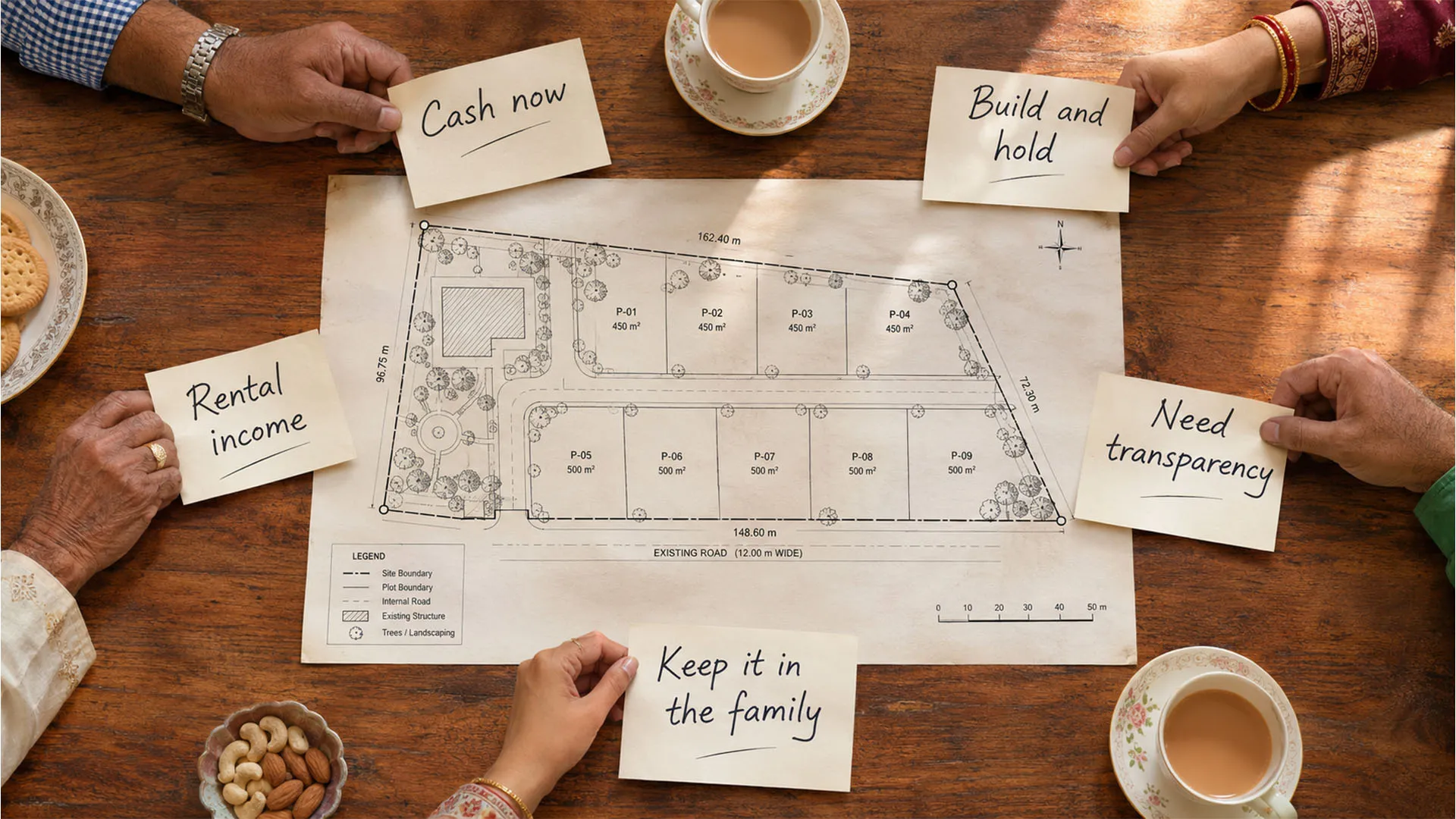
Why Jointly Owned Family Land Gets Stuck
Most families genuinely want to unlock the land. They stall because each co-owner arrives with a different financial situation, timeline and appetite for risk.
- Cash now vs. wealth later. Some co-owners want to sell and realise their share. Others would rather hold and build value over ten years.
- Different visions. Apartments, a commercial building, and a few rental units kept back: each sibling may picture a different best use. Without an objective view of what the plot allows, every opinion carries equal weight.
- Trust in execution. Delayed projects, cost overruns and builders who go quiet are part of Bengaluru’s collective memory. Caution is a reasonable response.
- Complicated title. Land passed down through generations often has several legal heirs, informal arrangements, and revenue records that don’t match the title documents.
Without a common framework, a valuable asset can sit idle for years. And the first step is always clarity on ownership.
Legal Groundwork Before Developing Inherited Property in Karnataka
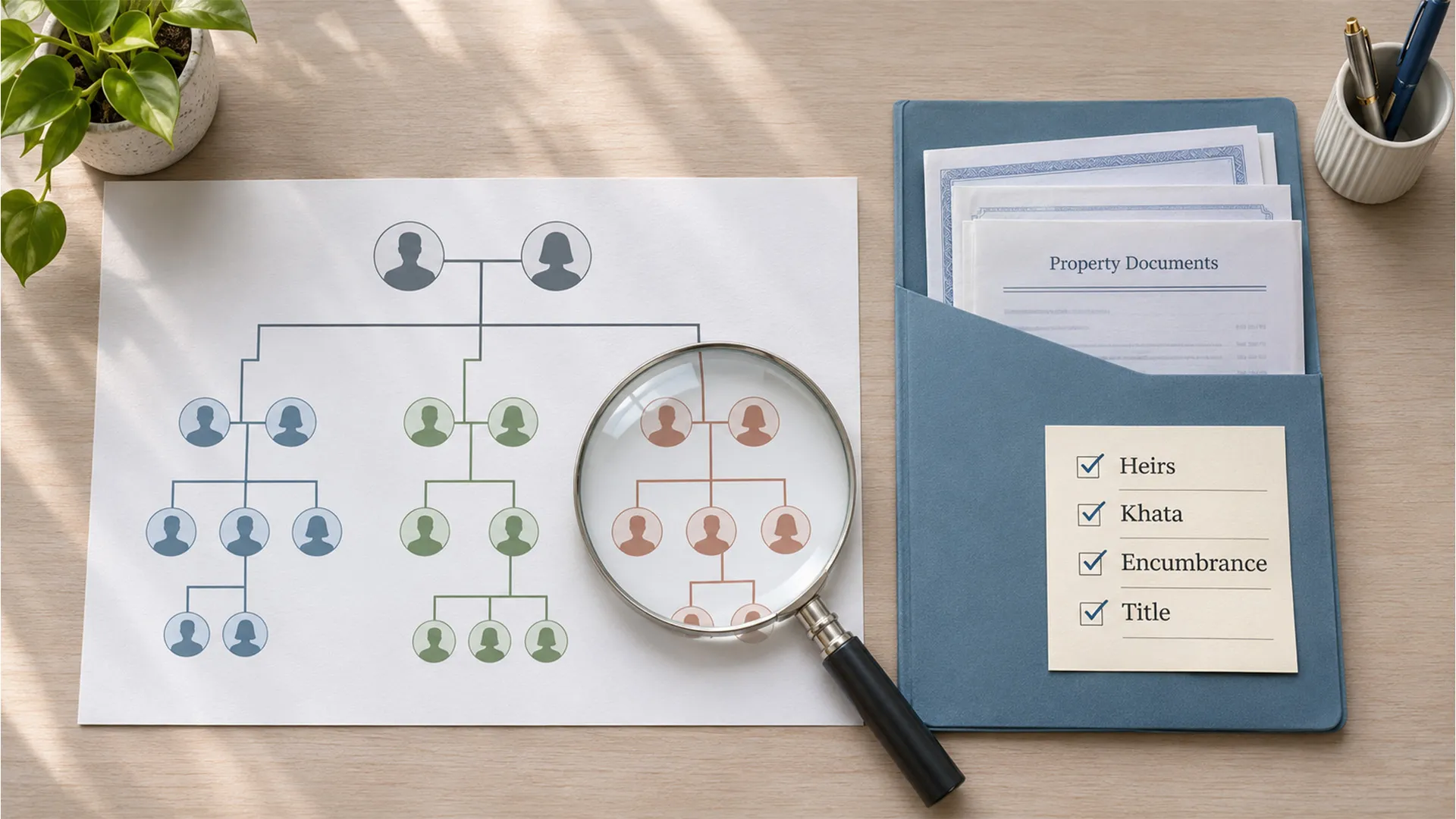
No development can begin until ownership is clear. Families should establish four things.
- Who the legal heirs are. Succession depends on the applicable personal law, the nature of the property and whether a valid will exists. For Hindu joint family (coparcenary) property, the Hindu Succession (Amendment) Act, 2005 made daughters coparceners with rights equal to sons. In Vineeta Sharma v. Rakesh Sharma (2020), the Supreme Court confirmed this applies whether or not the father was alive in 2005. Every rightful owner must be identified and their consent obtained.
- Whether any owner is a minor. A minor’s interest comes with extra safeguards under guardianship and property law, including court approval where required.
- The family tree. A documented Vamshavruksha records the succession history. Back it up with death certificates, wills, partition deeds, release deeds and other ownership records, as applicable.
- Clean property records. Legal due diligence should cover:
- Title documents and chain of ownership, typically for at least 30 years
- Encumbrance Certificate, mortgages and charges
- Khata status: in Bengaluru, check whether the property has an e-Khata and whether it is an A-Khata or B-Khata, since this affects approvals, loans and saleability
- Mutation records and property tax receipts
- Zoning, permissible FAR, setbacks and any TDR potential under the applicable regulations
- Easements, restrictions and pending litigation
Any mismatch between revenue records and title documents should be fixed before development is even discussed. Clear title is the foundation of any feasibility.
The Traditional Joint Development Agreement (JDA)
The JDA is the route Bengaluru landowners know best. The owner contributes the land, the developer funds and builds, and the finished project is divided in an agreed ratio, often between 40:60 and 50:50 depending on location and feasibility.
For many families it works well, and its biggest advantage is simple: landowners put in no capital. Before signing, though, weigh four things.
- Commercial terms. Understand the sharing ratio, the cost assumptions and each party’s obligations. Stamp duty and registration charges under Karnataka law also apply.
- Reliance on one developer. Timelines depend on the developer’s balance sheet, approvals capability and sales strength. Their difficulty becomes your delay.
- Visibility. With several co-owners, everyone wants updates on progress, spend and sales. Agree on how reporting will work before signing, not after.
- Tax. For individuals and HUFs, capital gains on a registered JDA are generally taxed in the year the completion certificate is issued, not when the agreement is signed. This provision, earlier Section 45(5A) of the Income-tax Act, 1961, is carried forward as Section 67(14)–(16) of the Income-tax Act, 2025, effective 1 April 2026. Conditions apply, so take professional tax advice.
So the question isn’t whether a JDA is good or bad. It’s whether the structure fits what every co-owner needs.
An Emerging Alternative: Developer as a Service (DaaS)
What if the family kept the land and brought in a developer’s capabilities instead of handing the whole project to one?
That’s the idea behind Developer as a Service (DaaS). The landowner stays the owner. A DaaS partner supplies the expertise, systems and networks a developer would, under a defined scope and a fee or entitlement structure.
Who funds the project? It’s the first question most families ask. In a DaaS model, the funding plan is set out upfront in the feasibility study. Capital can come from project finance, structured funding arranged by the partner, the landowners’ own contribution, or a mix, depending on what the family chooses.
DaaS rests on three pillars:
- Money. Feasibility, financial planning and access to capital, with funding closed before construction begins.
- Material. Organised procurement through institutional supply networks, for better price visibility and availability.
- Management. Structured execution across design, approvals, construction, sales and handover, with defined milestones and accountability.
How the Options Compare
| Outright sale | Traditional JDA | Developer as a Service | |
|---|---|---|---|
| Land ownership | Transferred | Development rights shared with developer | Retained by landowners |
| Capital from landowners | None | Typically none | Depends on funding plan |
| Share of upside | Sale price only | Agreed ratio of built area | Full project value, net of costs and partner fees |
| Control over decisions | None | Limited | Higher, by agreement |
| Best suited for | Families needing full, immediate liquidity | Owners wanting zero capital involvement | Families wanting ownership, visibility and control |
Each route can be the right one. The choice should follow the feasibility numbers and the family’s priorities.

How a Structured Approach Serves Different Family Needs
The real value of structure is that disagreements get settled on facts, not on who argues the loudest.
One set of numbers for everyone. A feasibility study shows permissible built-up area, costs, revenues and timelines. Every co-owner looks at the same data.
Different outcomes from one project. Depending on feasibility and the legal structure, co-owners can take different paths:
- The sibling who needs liquidity can explore a structured buyout of their share.
- Those building long-term wealth can hold their share of the finished units.
- Those who want income can keep residential or commercial units for rent.
- Family members overseas can follow progress through digital reporting.
Visibility for every owner. Regular reporting on construction, approvals, spend, sales and collections keeps each co-owner informed, wherever they live. Unitern’s Project Health Index is built for exactly this.
Clear decision rights. A well-drafted agreement spells out responsibilities, approval processes, timelines and how disputes are resolved, so one disagreement doesn’t stop the whole project.

Six Steps to Develop Joint Family Land in Bengaluru
- Confirm ownership. Have a property lawyer verify title, succession, Khata status and encumbrances, and identify every legal heir.
- Align the family. Appoint one family representative. Record what each co-owner needs: liquidity, income, a long-term hold or an exit.
- Run a feasibility study. Establish what the land permits, what it costs to build, what it can earn and how long it takes. Compare the result with selling or holding.
- Choose the model. Weigh an outright sale, a JDA and Developer as a Service on ownership, capital, upside, control and risk.
- Document everything. The agreement should cover scope, funding, entitlements, milestones, decision rights, default and termination, and dispute resolution. Execute and register all instruments as required.
- Select the partner. Look for a proven track record, transparent reporting and clearly assigned accountability.
About Unitern
Unitern is a Developer as a Service platform built on Money · Material · Management. Its purpose: bringing predictability to Real Estate.
- Money. Feasibility-led financial planning, with ₹350 Cr+ in capital access.
- Material. Organised procurement through its parent, Arisinfra Solutions Limited, a listed construction materials procurement platform that gives projects access to institutional supply networks.
- Management. Structured execution from feasibility and approvals through construction, sales and handover.
- Visibility. The Project Health Index (PHI) tracks 90+ parameters across 7 pillars, giving every co-owner the same view of progress, sales, collections and finances, from Bengaluru or abroad.
Related Reading
- Developer-as-a-Service: What Is It and How Does It Work?
- Revenue Sharing Real Estate Development in Bengaluru: A Landowner’s Guide
- Mastering Property Due Diligence: Essential Steps for Smart Real Estate Investing
Frequently Asked Questions
1. Can inherited land in Bengaluru be developed if one sibling doesn’t agree?
Generally, no. Development needs the consent and legal authority of all owners. The options include a negotiated settlement, partition, a buyout of the dissenting share, or legal proceedings. A property lawyer can advise on the right remedy for your situation.
2. What documents are needed to develop ancestral property in Karnataka?
Typically: title deeds, succession documents, death certificates, partition or release deeds, Encumbrance Certificate, Khata (including e-Khata status in Bengaluru), mutation records, property tax receipts and a Vamshavruksha. The exact list depends on the property’s history.
3. Do daughters have equal rights in ancestral property?
Yes, for Hindu Mitakshara coparcenary property. The Hindu Succession (Amendment) Act, 2005 gave daughters equal coparcenary rights, and the Supreme Court held in Vineeta Sharma (2020) that this applies even if the father died before 2005. Self-acquired property follows different rules.
4. How is a JDA taxed in 2026?
For individuals and HUFs with a registered JDA, capital gains are generally taxed in the year the completion certificate is issued. This rule now sits in Section 67(14)–(16) of the Income-tax Act, 2025 (formerly Section 45(5A) of the 1961 Act). Conditions apply, so consult a chartered accountant.
5. What’s the difference between a JDA and Developer as a Service?
In a JDA, the developer builds in exchange for a share of the finished project. With Developer as a Service, the landowners keep ownership and bring in a partner for finance, procurement and execution, subject to the contract.
6. Can different siblings get different outcomes from one project?
Yes. Depending on feasibility and the legal structure, one co-owner can take a buyout while others hold units or keep rental assets.
7. What does a feasibility study for family land include?
Permissible built-up area under zoning and FAR rules, construction cost, expected revenue, funding plan, approvals path and timeline. It gives every co-owner the same basis for a decision.
Disclaimer: This article is for general information only and does not constitute legal or tax advice.
.webp)